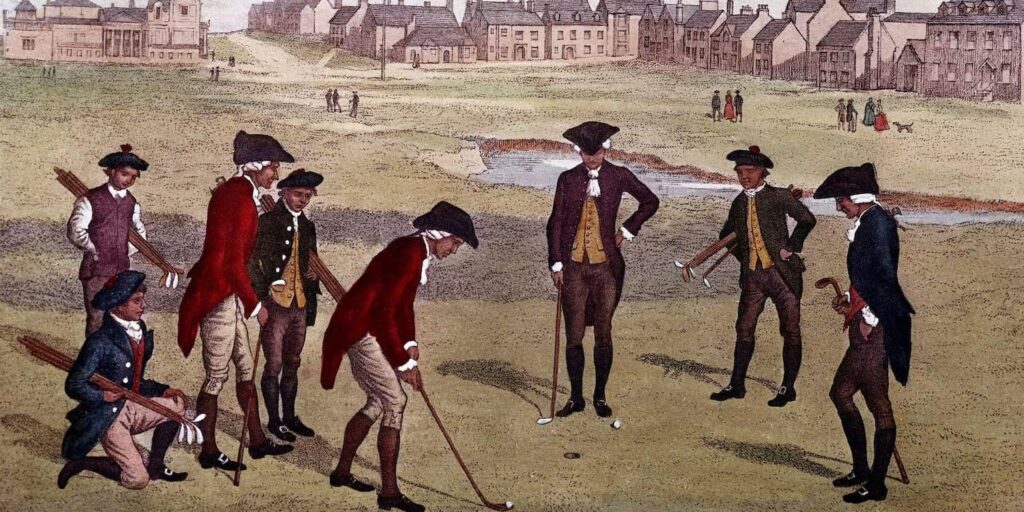
In 1457, Scotland’s parliament banned golf. The reasoning was blunt: too many Scots were smacking balls across the linksland when they should have been practicing their archery against the English. What nobody in King James II’s court likely paused to consider was that the very word they used for this forbidden game — gowf — carried the echo of a language spoken by men who had arrived on Scottish shores six centuries earlier, uninvited and heavily armed.
The word “golf,” traced through Middle Scots, loops back through the Dutch colf to the Proto-Germanic kulth-, and from there to Old Norse kolfr, meaning the clapper of a bell, or more broadly, a club, a mace, a striking implement. The Icelandic descendants of that same root — kylfa and kylfi — still mean “cudgel.” The etymology isn’t disputed; it’s just rarely discussed in its full context. When we talk about the origins of Scotland’s most famous export, the conversation tends to skip from “medieval Scots” to “modern golf” without much thought about who shaped the culture in between.
The Norsemen Were Already There
By the time golf appeared in Scottish records, the Norse had been part of Scotland’s story for over 600 years. Norwegian settlers reached Orkney and Shetland by the late 700s. Within a century, they controlled a swathe of territory that stretched from the Northern Isles down through the Hebrides, Caithness, and Sutherland, and all the way to the Isle of Man. They weren’t just passing through. DNA studies show that Shetland today is 44% Norse, Orkney 30%. Even the Hebrides, further from Scandinavia, carry 15–20% Nordic genetic heritage.
This wasn’t a quiet cultural exchange. The Norse effectively replaced the Pictish language in the Northern Isles, left behind thousands of place names (Thurso comes from Thorsá, “Thor’s River”; Sutherland from Suðrland, “south land,” south of Orkney), and governed the islands under their own legal system for centuries. Orkney and Shetland remained officially Norwegian until 1468. The Hebrides were ceded to Scotland only in 1266, after the Battle of Largs.
So when golf emerged on Scotland’s east coast in the 1400s, it appeared in a country whose northern and western coastlines had been shaped, linguistically and genetically, by Norse settlement. The linksland where Scots chased balls with bent sticks sat, in many cases, on terrain that Viking settlers had grazed, farmed, and fought over.
A Word Born from a Club, or a Blow?
The etymology is worth sitting with for a moment. The Old Norse kolfr had a broader meaning than just “bell clapper.” Grimm connected the Scandinavian kólfr to arrows, bolts, javelins, and throwing clubs. The compound kôlf-skot meant the distance of an arrow-shot, a measurement that only makes sense in open country, the kind of flat, treeless terrain where a projectile won’t vanish into brush. Some etymologists have pointed out how much that description sounds like linksland: the wind-blasted, gorse-dotted, sandy coastal stretches where golf took root.
The Scottish Golf History project notes that the derivation runs from “striking” to “club” and then to the game played with that club. Another camp argues gowf is a purely Scots word meaning “to strike” or “to drive forward with violence,” recorded in 18th-century dictionaries. These theories aren’t mutually exclusive. The Norse and Gaelic languages coexisted in Scotland for centuries; Scottish clans with names like MacIvor (sons of Ivar), MacAskill (sons of Asgeir), and MacSween (sons of Swein) are living evidence of that overlap.
Sticks and Balls Before the First Tee
The Norse brought more than words. They brought a culture of outdoor sport played with sticks and hard objects, under conditions that could generously be described as hostile.
Entertainment in the Viking Period included knattleikr, a ball-and-stick game played by Viking communities in Iceland and across Scandinavia from roughly the 9th through 11th centuries. Described in multiple Icelandic sagas — Egils saga, Grettis saga, Gísla saga, Eyrbyggja saga — the game involved teams using wooden sticks to hit a hard ball, with body contact not only permitted but expected. Matches lasted from morning to night, drew enormous crowds, and occasionally ended with someone being killed. In Egils saga, the young Egil Skallagrimsson murdered a boy with an axe after losing repeatedly. (Viking sportsmanship had a different flavour.)
The game was typically played on frozen ponds or flat, open ground — terrain that, again, parallels the coastal links of Scotland. No trees, no obstacles beyond the natural landscape, and relentless wind. The tools were wooden sticks and a hard ball, possibly made of wood or tightly packed leather.
Nobody is claiming that knattleikr was proto-golf. The two games look nothing alike in structure. But the idea that Norse settlers in Scotland had no tradition of stick-and-ball play, and that their centuries-long presence on Scottish soil left zero imprint on the recreational culture that eventually produced golf, requires a deliberate act of historical amnesia.
Where Vikings Settled, Golf Followed
Here’s a detail that rarely makes the tourism brochures. Royal Dornoch, consistently ranked among the top ten courses in the world, sits in Sutherland — a county whose very name is Old Norse. The Dornoch area saw Viking raids beginning around 850 AD. Norse settlers eventually intermarried with local Picts, and their place names still dot the landscape: Skelbo, Embo, Brora. Royal Dornoch’s own website acknowledges this heritage plainly, noting that “to the seafaring, marauding Vikings one thousand years earlier, it was Suderland — the Southern Land.”
Golf at Dornoch can be traced to 1616, making it the third oldest golfing town in the world. The linksland where Tom Watson once played two rounds in a single day, calling it the most fun he’d ever had on a course, was originally settled by people who played their own stick-and-ball games centuries before the first Scottish parliament got around to banning gowf.
Then there’s Crail, the seventh oldest golf club on the planet, founded in 1786 on the east coast of Fife. When the American architect Gil Hanse was hired to build Crail’s second course, Craighead Links, in 1998, he won the project partly because of his determination to incorporate the Danes Dyke into the course routing. The Dyke is a 1,200-year-old stone wall built by Viking invaders as a defensive barrier against the local Pictish tribes. It now comes into play on four holes. You can hit a 7-iron over a wall built by Norsemen, and most golfers don’t think twice about it.
The Missing Chapter
The standard history of Scottish golf goes something like this: medieval Scots played a stick-and-ball game on coastal links; the Scottish parliament banned it in 1457; the ban was lifted in 1502; Mary Queen of Scots played it; clubs formed in the 1700s; the modern game spread worldwide. The Norse are mentioned, if at all, only in the etymology section, usually as a footnote about Old Norse kolfr.
What’s missing is context. Golf didn’t emerge in a cultural vacuum. Scotland’s east coast — where the game first took root — was a trading zone with deep connections to Scandinavia, the Low Countries, and the Baltic. Scottish merchants settled in Dutch ports; Flemish traders operated in Scottish harbours. The Dutch game of kolf (played with a stick and ball toward a target) is often cited as a potential ancestor of golf; less often discussed is that Dutch kolf and Old Norse kolfr share the same Proto-Germanic root. The Norse influence on both Scotland and the Netherlands created a web of cultural transmission that predates the first written reference to golf by centuries.
Scotland’s Highland and island communities, meanwhile, played shinty — a stick-and-ball sport with roots going back nearly 2,000 years, brought from Ireland along with Christianity and the Gaelic language. Shinty was the dominant game in the Highlands, precisely the areas where Norse settlement was heaviest. Wikipedia’s own entry on Golf in Scotland notes that “shinty (a game which may share a common ancestry with golf) is often the traditional sport” in the Highlands and Islands. Whether the Norse game traditions influenced shinty, or shinty influenced the Norse settlers, or both games simply coexisted in a landscape where hitting objects with sticks seemed like an obvious way to spend a Scottish afternoon — nobody can say with certainty. But the overlap is real.
The Ground Remembers
Walk the links at any of Scotland’s great northern courses and you’re walking ground the Norse settled. The sandy, wind-hammered terrain that makes links golf unique — the firm turf, the dunes, the absence of trees — was the same landscape that Norse farmers worked and Norse children played on. The linksland was too sandy for crops but perfect for grazing; it was common ground, open to everyone. That egalitarian tradition persisted into golf’s early centuries and still shows up in the public courses and charitable trusts that distinguish Scottish golf from the private-club model elsewhere.
The word “links” itself comes from Old English hlinc, meaning “rising ground” or “ridge.” But the game played on that ground carries a name with Norse bones. The sticks used to play it echo a word that once described a Viking weapon. And the courses where millions of golfers make their pilgrimages sit on land where Norse settlers lived, fought, and played their own rough games a thousand years ago.
Scotland doesn’t need to share credit for inventing golf. The modern game — with its 18 holes, its codified rules, its culture of clubs and competitions — is Scottish through and through. But the Scots who built that game were themselves a composite people, shaped by Picts and Gaels and Romans and, quite significantly, by the Norse who arrived with their longships, their place names, their laws, and their kolfr. Pretending otherwise doesn’t make for better history. It just makes for an incomplete one.